Photos and interview by Renan Garcia
What led you to study social work?
I knew I wanted to skate, but I also knew I wouldn’t be able to live off of that. So, I started looking into other options and found this degree in social work. What drew me in was how interdisciplinary it was—you learn about psychology, politics, education, and much more. Plus, it’s very practical, which I preferred over something more theoretical, like social sciences. I didn’t start with big expectations or a fixed plan, but it turned out to be a great decision. Not only was it interesting, but it helped me grow as a person.
What are some key lessons from your studies that you see reflected in skate culture?Well, I think skating teaches resilience—how to keep going despite challenges—and how to approach problems from different angles. That’s definitely a useful skill in social work, where you have to adapt to different situations all the time. Especially when working with kids, situations can be unpredictable, and you need to stay calm and respond accordingly. Social work can be really challenging, so it’s also important to know your limits—when to step back and take care of yourself. That’s something skateboarding teaches you too. Sometimes, you need to take a break, reassess, and then try again. Based on what I’ve learned in my studies, I’d like to see more self-reflection in skate culture—critically questioning our own privileges. For example, asking: How diverse is the group I skate with? Why might certain people not feel included? Skate culture prides itself on being open and welcoming, but it’s still important to challenge ourselves and be aware of who is and isn’t showing up—and why.Do you think skateboarding can help with youth development and mental health?Yeah, for sure. There’s a great project in Canada called Push to Heal, led by a guy named Joel Pippus. They use the Neurosequential Model, a therapeutic framework, and combine it with skateboarding as a trauma resilience tool. Their work shows a strong connection between skateboarding and mental health. You should check it out, if you’re interested in that topic.Do you think skateboarding can be a tool for social change?Yes, definitely. There are already great projects around the world doing this. Skateistan, the Goodpush Alliance, and when I was in Athens, Greece, I found out about Free Movement Skateboarding—they do great work with displaced youth in and around Athens as well as planning community events. It also depends on how you define social change. For me, even small positive impacts can contribute to a larger social transformation.
How do you see your studies influencing your future involvement in skateboarding?I definitely want to keep pushing the idea of using skateboarding and skate workshops as a tool for working with youth. That’s what I wrote my master’s thesis on, and I feel like I’ve just scratched the surface of that field. I think combining those two worlds—academic research and real-world skateboarding—could be really valuable and could lead to meaningful progress.
Has traveling influenced your perspective on social work?Definitely. Traveling has shown me how different social systems are from country to country. The level of government support and the role of NGOs vary a lot, and it made me realize not to take the social services we have in Germany for granted. It’s also been eye-opening to see how much better the working conditions are in Germany compared to many other countries. Seeing things on a global scale really puts them into perspective.
What scares you or causes anxiety in life? What are your main preoccupations?If we look at the world today, there are definitely a lot of things that are scary. The state of world politics, the ongoing wars, and the climate crisis —those things are really concerning. But at the same time, for me it’s important to not dwell on them all the time for the sake of my mental health. Although it’s a big privilege to be able to take a step back every now and then. That said, I do get anxious about the future. For example, in Germany, the far-right party (Fuck AFD) just gained a significant number of votes in the recent elections, and that’s pretty scary. It makes me wonder how history can repeat itself like that. It’s important to ask myself, how do I respond to that fear? Does it paralyze me, or does it motivate me to stand up against it?
Sasha Scharfe: Would you rather be able to do every skateboard trick perfectly from the start, or speak every language in the world?That’s a tough one. But I think I’d go with speaking every language in the world. That would open so many doors. I love learning languages and picking up slang when I travel, but to really learn how to speak a language requires so much time and effort. Right now, I’m in Brazil and it’s tough when I’m surrounded by Portuguese and can’t understand everything. It would be amazing to just be able to connect with everyone. But then there’s also the beauty of still making it work even though you don’t speak the same language. As for skateboarding, I think if I could do every trick perfectly right away, it might actually get boring. Part of the magic of skateboarding is working hard for your tricks, the process of trying over and over, and the feeling of success when you finally land something.
You’ve been traveling for a decade now. What inspired your desire to see the world?Honestly, it was the year I spent in South Africa after school. Before that, I’d gone on a few skate trips with friends, typical stuff around Europe, or other cities in Germany. But moving to South Africa changed everything for me. I didn’t know much about the country or the skate scene, but once I got there, I was so positively surprised. The people, the spots, the culture—it was way better than I could’ve imagined. After that experience, I realized I wanted to travel deeper, not just for a week to skate and leave again, but to really get to know a place and the people. And skateboarding is a great tool for doing that.
Sascha: Which city do you think is the most underrated place to skate that’s not really on the radar?For me, it was Athens. When I first moved there in 2022, I was really surprised by how many great spots there were. I remember going to some spots with my friends, and I’d be like, “How have we not skated this yet?” because there’s just too much to skate and still new spots to explore. However with events like the CPH Open, that they did there last year, and the Stroller Crew filming videos and organizing events, the city is being put more on the map.
Rubens Dos Santos: How do you balance studying, working, traveling, and still managing to get sick clips and keep everything together?Good question, Rubens. Rubens is like my brother, we’ve been living together in Madrid and Berlin for the past six years, so we share a lot. Keeping a balance isn’t easy, and to be honest, sometimes it feels like I’m losing it. But what always helps me is some sort of routine, and also spending my time with very different things. I always tried to link my studies with my travels; I did a social year in South Africa, a semester abroad in Madrid, and then an internship in Athens. This way, I was able to live in a new place for a few months and really connect with the local scene, without just doing vacations. The German government supports initiatives like that, which is a great opportunity to make it work on a low budget. I’ve also been lucky to find a really good job in Berlin. They’re flexible, so I can work a bit more before taking time off to travel, and then always come back to work there. The salary in Germany also helps, for sure—it opens a lot of doors for traveling. And when I’m on trips, I try not to spend a lot. I try to stay with friends or on people’s couches. It keeps things affordable. However, traveling all the time can make me feel like I’m not fully at home anywhere, having a routine in Berlin helps me to keep grounded.
Mike Brauer: What’s next for you in your early thirties?I’m still 28, so I’ve got a couple of years before I hit 30 (laughs). But I’m definitely starting to think ahead more. I just finished my master’s in social work, which feels like a big step. I also just released a skate part with Pocket. So it felt like a good time to take some time off. Right now I’m in Brazil, skating and traveling around. I’ll have another part coming out from these adventures soon. Skating-wise, I’m hopeful that some more opportunities will open up. But if not, I’m happy with my job in Berlin. I work at a kids’ and youth program three days a week, so it gives me the freedom to skate and travel whenever I want. For the next few years, I just want to keep doing that, with Berlin as my base. It’s been working out well for me to not try to plan too much ahead and work on one thing at a time, so I’ll stick to that for now. I like the thought of not knowing what I’m gonna be doing in one year from now.
What’s your travel setup like? Do you pack light, or do you bring everything?I always try to pack light. That’s one of the first lessons I’ve learned through bringing way too many clothes, I end up not even wearing. The nice thing is that most places have what you need, and you can always pick up some cool souvenir shirts, for example. But boards are a pain. They’re heavy, but you have to bring spare boards for sure, so I tend to pack less clothing and bring more boards.
Have any specific cultural experiences while traveling changed the way you look at skateboarding?It’s not a specific experience, but traveling has taught me not to take myself too seriously and not to stress about having everything planned out perfectly. It’s a good lesson that applies to skateboarding too. You don’t need to plan every detail or worry too much about getting clips, because then it’s not gonna work anyway. Sometimes, just going with the flow makes everything come together.How do you balance traveling with filming?It pretty much goes hand in hand for me. When I travel to a new place, I want to skate the spots and get clips. But I also try to make time to see the nature of the place. And I like to take a day off every now and then, go to a museum, or see some things that are not necessarily skate related.
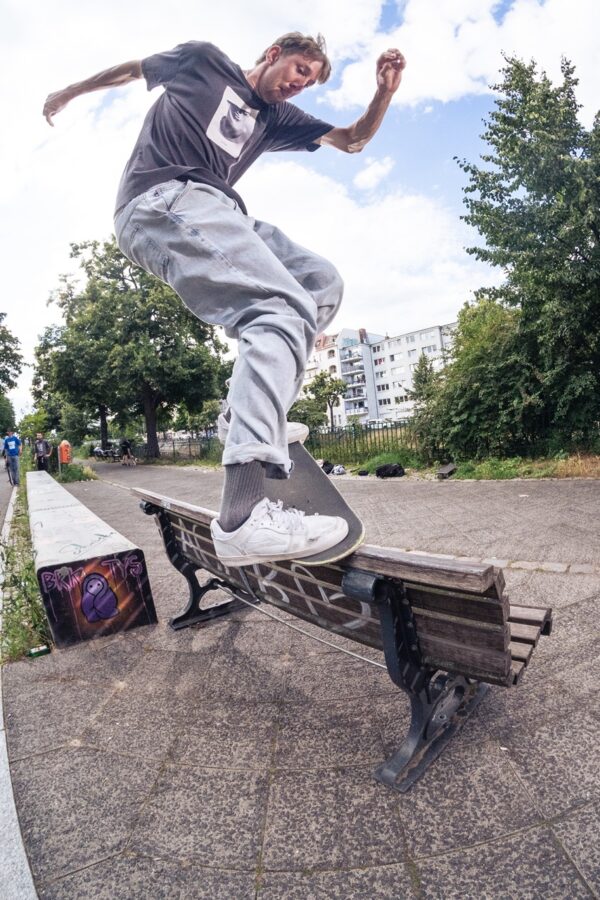
What’s the biggest challenge of constantly being on the move as a skater?The biggest challenge for me is not burning out. If you’re always skating, talking about skating, surrounded by skaters, it can get very overwhelming. I need to do other things to stay balanced, whether it’s hanging out with people who don’t skate, my job, or my studies. These things help to take my mind off skating so I don’t get mentally exhausted. Having that balance keeps me focused and recharged.